 Tazeen Akhtar
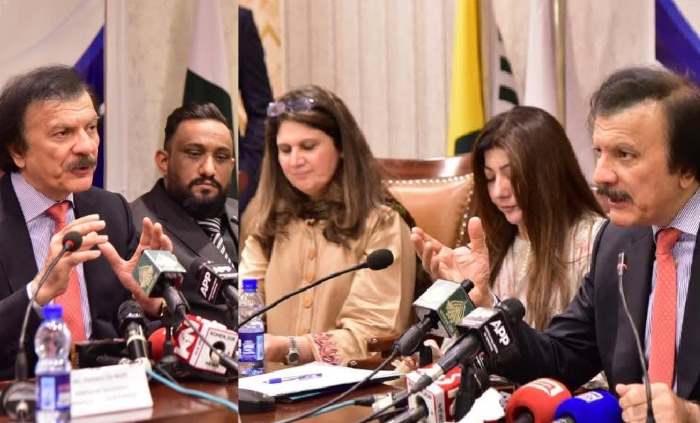
Haroon Akhtar Khan, Special Assistant to the Prime Minister and Minister-in-Charge for Industries and Production has shared with the stake holders that Pakistan is preparing its first Gold Policy. He did not give the details neither he shared this before the representatives of the minerals and mines association pointed out that Pakistani gold is going to China in the name of refining and Pakistan does not have any facility to refine its own the most precious minerals.
The venue was MSME day event at Rural Development Foundation Islamabad as the joint venture of Small and Medium Entrprises Development Authority and Islamabad Small and Medium Chambers of Commerce Islamabad. Federal Secretary Industries Humaira Zia Mufti, Chairperson SMEDA Ms Nadia Jahangir, President ICCI Sardar Tahir Mehmood, President RCCI Usman Shaukat, President Women Chamber of Commerce Samina Fazil and President Small Chamber Awais Satti were also present.
On the occasion of World MSME Day 2026, SMEDA also organized awareness programs, stakeholder sessions and consultative meetings in various major cities of the country, aimed at promoting business activities, increasing the competitiveness of local industries and delivering government support to the MSME sector in a more effective manner.
SMEDA Chief Executive Officer, Nadia Jahangir Seth, highlighting the key initiatives under the organization’s three-year business plan, said that SMEDA is actively working to make Pakistani MSMEs more competitive, trustworthy for financial institutions and connected to global markets through business registration, export readiness, international certification, digital transformation and eco-friendly business development.
Haroon Akhtar in his keynote address shed light on the steps government is taking to strengthen SMEs. He said remarkable growth has been noted in this sector. According to the State Bank of Pakistan, SME financing rose from Rs 584 billion to approximately Rs 854 billion by March 31, 2026, marking a 46 percent annual increase.
During the same period, the number of SME borrowing businesses grew by 53 percent, surpassing 312,000. These figures were cited as an indication of growing confidence in Pakistan’s business environment.
Highlighting the contribution of SMEs, he said Pakistan has around seven million SMEs, contributing nearly 40 percent to the country’s GDP, around 30 percent of exports and employing nearly 80 percent of the non-agricultural workforce.
He said SMEDA is actively working to strengthen the SME ecosystem by improving access to finance, promoting formalization and documentation of businesses, and enhancing their competitiveness in domestic and international markets.
He emphasized that formalization of businesses is essential, as registered enterprises can easily obtain bank financing and benefit from government support programmes.
He said the government is connecting Pakistani SMEs with international markets through digital platforms and has signed a Memorandum of Understanding (MoU) with Alibaba to facilitate online exports and e-commerce opportunities.
He added that Pakistani SMEs are also being encouraged to participate in regional and international trade expos, while efforts are underway to facilitate visa access for exporters. Outreach programmes have also been expanded to Gilgit-Baltistan, Balochistan and Khyber Pakhtunkhwa to connect regional industrial clusters with national and global markets.
Samina Fazil took Haroon Akhtar hard and raised the issue of inclusiveness of women entreprneurs in the decision making processes. She said , gov is not taking women on board. There is nothing in the federal budget for the women doing business.
She said SMEDA is conducting training workshops but through the third party. TDAP is working with big businessmen only. She criticized allocation of hundreds of billions for BISP and said , gov is making the women beggars. Her remarks were welcomed by the participants who appreciated her with big applause.
Here it is worth mentioning that one can easily see what are the priorities of the government. To help small and medium women entrepreneurs stand on their foot and contribute in the economy of Pakistan or make the most of them charity seeking burden on the society only. As Haroon Akhtar said, 30 billion allocated for small businesses while at the other hand 838 billion have been pledged for BISP.
The government has allocated a historic Rs 838 billion for the Benazir Income Support Programme (BISP) in the FY 2026-2027 budget, up from Rs 716 billion in FY 2025-2026. This nearly 17% increase is designed to expand nationwide social coverage and ease the impact of rising energy tariffs.
Mir Behroz Riggi, Chairman Mines and Minerals Association Balochistan drew the attention of Haroon towards the poor status of miners in the province. He sought industry status for the mines where more than 15 thousand people are working. He demanded railway connectivity for the mines.
He pointed out that lack of refineries for the minerals compels the country to send the gold to China. He emphasized the need of setting up of refineries to refine raw gold in the country. He asked for Pakistan Mineral Development Corporation to be activated whose work has been given to other people. He did not clarified who are the people.
Abdul Qayyoom, from KP said mines sector badly needs peace and investment in the province. He said there is no peace in the province. Trade with India banned , Afghanistan border closed and the export of Marble to India stopped after 2019. Marble and Gypsum work is shut down because of these factors.
Haroon Akhtar Khan listened to the suggessions and called them to meet him in the office to discuss the matters in detail.
Here it is worth recalling that CDF, Field Marshal, COAS General Asim Munir , after assuming the office of Chief of Army Staff, boosting the moral of the nation, in his addresses mentioned the wealth of minerals in Pakistan. He presented some rare minerals to President Trump in Washington during his early visit. And how unfortunate this reality is, that Mines sector still seeking the status of industry. And Pakistan does not have refineries or any such facility to refine minerals like gold even from the raw materials.