 MOHAMMAD ISHAQ DAR
Deputy Prime Minister – Minister of Foreign Affairs Pakistan
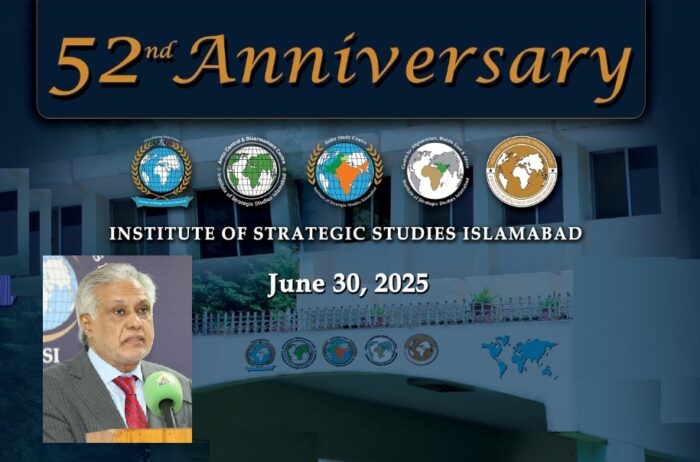
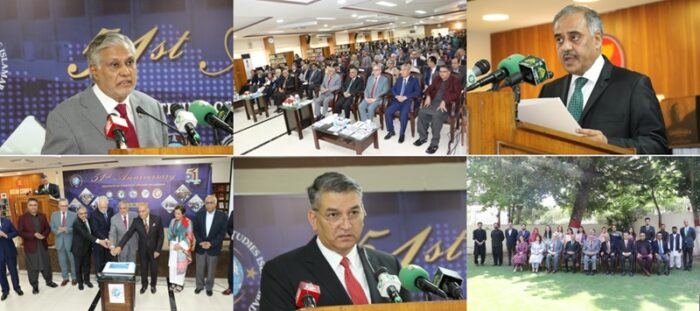
Address at the Commemoration of 52nd Anniversary of the Institute of Strategic Studies Islamabad (ISSI) (30 June 2025) in the presence of Foreign Secretary Ms Amna Baloch, Ambassador Khalid Mahmood, Chairman BoG, Ambassador Sohail Mahmood, Director General, Dean of Diplomatic Corp, Ambassador Turkmenistan Mr. Atadjan Movlamov
It is a distinct privilege for me to join you all in commemorating the 52nd anniversary of the establishment of the Institute of Strategic Studies. Since its founding in 1973, ISSI has evolved into one of Pakistan’s foremost strategic think-tanks. It is rightfully known for generating quality research, promoting thought leadership, and fostering inclusive dialogue among diverse stakeholders.
The Foreign Office values the ISSI’s pivotal role in bridging the gap that usually exists between academic research and policy formulation. As Patron of the Institute, I am proud of the work ISSI does to enrich the policy process, reinforce our foreign policy goals, amplify Pakistan’s narrative on vital issues, and expand regional and international outreach.
I take this opportunity to extend sincere felicitations to the leadership and research faculty of ISSI. We look forward to continuing our strong partnership as we navigate the complex and rapidly evolving geopolitical landscape together.
Our world today is in deep turmoil – marred by intense wars and military conflicts, humanitarian catastrophes, existential threat of climate change, wilful disregard and violation of international law, erosion of time-honoured norms of inter-state relations, and diminishing effectiveness and credibility of institutions of global governance.
Flux and uncertainty reign supreme, while the international community remains deeply polarised. The scale of human suffering and material damage continues to mount phenomenally.
At a different level, our world is passing through another “hinge” moment in history. A profound transformation is taking place in the global order. The globe is witnessing changes unseen in a century. The unipolar moment is long gone; by all indications, the world is moving towards multi polarity.
The peaceful rise of China, attempts to ‘contain’ China’s rise, resurgence of Russia, increasing salience of Eurasia in global geopolitics, emergence of ‘Middle Powers’, and growing role of the ‘Global South’ are some of the prominent features of this transitional phase.
 In essence, major-power contestation on the one hand, and increasing agency of multiple new actors on the other, present an incredible mix of challenges and opportunities for statecraft everywhere.
Amidst this global turbulence and transformation, Pakistan is charting a forward-looking course as a confident and self-assured nation – resolutely safeguarding its sovereignty and territorial integrity and shouldering its obligations as a responsible member of the international community.
Both as a Middle Power and a key member of the ‘Global South’, Pakistan is contributing to the worthy causes of peace and security as well as sustainable development. Our strategic and constructive engagement with the world community has been pivotal for ensuring a secure and prosperous future for Pakistan. By the grace of Almighty Allah, our global profile continues to rise.
The mettle of our nation was tested again recently — with India’s unfounded allegations following the Pahalgam attack, and its unprovoked aggression in May 2025. Pakistan swiftly retaliated to the Indian escalation with a “quid pro quo plus” response – which is the “new normal” set by Pakistan if India insists on its dangerous notion of ‘limited war under the nuclear threshold.’ The outcome of this 4-day war has once again underscored the reality that India can neither intimidate nor coerce Pakistan. New Delhi must, therefore, rethink its present hubristic and misguided policies that threaten peace and undermine security in South Asia.
Pakistan also remains determined to protect its rights and entitlements under the Indus Waters Treaty (IWT). We firmly reject attempts by India to weaponise water in pursuit of its narrow geopolitical objectives. India’s illegal and unilateral action of putting the Treaty “in abeyance” has no validity.
Pakistan will continue to mobilise all relevant international and legal fora to highlight India’s violations of international law and the Treaty’s provisions. We have made clear that any action by India to divert the flow of water would be considered an “act of war.” Pakistan will not allow India to hold its 240 million people hostage to “hydro-terrorism.”
Pakistan values the efforts of all friendly countries, including the U.S., KSA, UAE, and Türkiye that resulted in preventing further escalation between India and Pakistan and putting the ceasefire in place. Going forward, it is essential to consolidate the ceasefire, institute a reliable crisis management mechanism, and develop confidence building measures that would help stabilise the regional security situation.
Beyond conflict management, moving towards dispute resolution is indispensable. Pakistan remains committed to peaceful and cooperative relations with all its neighbours, including India. We believe in peace – but with dignity and honour, and on the basis of mutual respect and sovereign equality. It is our considered view that sustainable peace in South Asia remains contingent on a just and lasting solution of the Jammu and Kashmir dispute in accordance with the UN Security Council resolutions and the wishes of the Kashmiri people.
Pakistan also believes that time has come to re-imagine regional cooperation in South Asia and in our extended neighbourhood. The negative impulses of dominance and hegemony have long stymied this process and made SAARC dysfunctional. Our region instead needs a positive spirit of solidarity, mutually-beneficial collaboration, and shared prosperity.
South Asian countries can constitute groups with variable geometry on issues from economy to technology to connectivity. Bangladesh, China and Pakistan have recently formed a trilateral mechanism to promote cooperation in a broad range of areas of common interest. Further such mechanisms can be envisaged with other South Asian states based on the principles of common interest, mutual benefit, and win-win cooperation.
Pakistan remains profoundly concerned about the recent developments in the Middle East. We condemned Israel’s completely unjustified aggression against Iran as well as the attack on Iranian nuclear facilities by the U.S. These actions, representing a highly dangerous escalation, have been in violation of the UN charter and international law.
Pakistan has consistently supported Iran’s legitimate right to self-defence under the Charter. We appreciate the constructive and pragmatic approach that Iran adopted in finding a negotiated solution to the nuclear issue.
The U.S.-Israeli actions seriously undermined the longstanding norms of inter-state behaviour and exposed the entire region to a conflagration of potentially unimaginable consequences. Pakistan has welcomed the announcement of the ceasefire between Iran and Israel. We stress again that all the relevant parties must constructively engage and resolve all outstanding differences and disputes peacefully through dialogue and diplomacy.
Israel’s genocidal war against Palestinians in Gaza continues to be a stain on the conscience of humanity. The wanton killing of children and women, use of starvation as an instrument of war, mass destruction of homes, schools, hospitals and critical infrastructure, and deliberate targeting of humanitarian workers have no parallels in history. These actions cannot be condemned enough.
The international community must mobilise to stop Israel from its murderous course and persuade it to pursue a path of reason. Palestinians must be granted their inalienable right to self-determination. Pakistan reiterates its unwavering support for the Palestinian people and calls for the establishment of a viable, independent and contiguous Palestinian state, with pre-1967 borders and Al-Quds Al-Sharif as its capital.
Pakistan has consistently supported this position all along and we continue to actively pursue it at the UN, OIC, and other international fora. We believe there can be no peace in the Middle East without justice for the Palestinians.
In recent months, we have purposefully made efforts to reset Pakistan-Afghanistan relations on a positive trajectory. My 19th April 2025 visit to Kabul and the China- Pakistan-Afghanistan trilateral Ministerial meeting on 20th May 2025 in Beijing paved the way for a qualitative change. Among other things, we agreed to upgrade our diplomatic representation to Ambassadorial level and extend CPEC to Afghanistan.
We believe that a peaceful, stable, united and prosperous Afghanistan is in Pakistan’s vital interest. Having made sincere efforts in Afghanistan’s interest, it is our legitimate expectation that the Afghan Interim Government would take all steps necessary to ensure that Afghanistan’s soil is not used for terrorism against any state, particularly Pakistan.
Ensuring this is in Afghanistan’s own interest as it will strengthen their internal security and improve their relations with neighbours, principally Pakistan. If the Interim Afghan Government works with complete sincerity and wholeheartedly, the fruits of our economic cooperation, efforts for regional integration, and connectivity would be enormous. Not only the people of Afghanistan will benefit tremendously but also the dividends of shared prosperity would extend to Central Asia and beyond.
While I have shared Pakistan’s perspective on some of the major hotspots globally, our overall foreign policy remains proactive and result-oriented. The Pakistan-China All-weather Strategic Cooperative Partnership continues to scale new heights; our longstanding ties with the United States are expanding in both scope and substance; and the relationship with Russia is growing into a partnership deemed vital by both sides.
We are fruitfully engaged with EU, Japan, and ASEAN; forging stronger collaboration with Türkiye, Saudi Arabia, UAE and other partners in the Gulf and the Islamic world; developing an enhanced partnership with Africa; and meaningfully reaching out to Latin America.
One of the core principles guiding this foreign policy approach is accentuating Pakistan’s pivot to geo-economics. I have personally spearheaded the thrust on economic diplomacy as part of our fundamental reorientation of the Foreign Ministry. Enhancing trade, promoting foreign investment, attracting remittances and technology flows, and forging development partnerships are among the highest priorities.
In this way, foreign policy becomes the most important instrument to protect and promote Pakistan’s economic interests and to substantially contribute to the process of national development.
The other core principle, in the external dimension, is our abiding commitment to international law, United Nations Charter, and UN-centered multilateralism. This is of utmost importance for effectively addressing the world’s complex, interconnected threats and challenges — pertaining to peace and security, climate change and sustainable development, terrorism and trans-national crimes, strategic stability and destructive arms races, misinformation and disinformation, and Islamophobia and inter-faith harmony.
As an elected member of the UN Security Council for the 2025–2026 term, Pakistan is actively engaged on all these issues and making practical contributions. Serving on this high table is indeed a unique honour, and I reassure you that Pakistan would remain a strong proponent of peace, international legality, justice, and collective solutions to common problems. We would make all humble efforts to become the voice of the voiceless and the power of the powerless!
With these words, I congratulate the ISSI on its Foundation Day celebrations again and thank them for providing the opportunity to share my thoughts with this august gathering. This platform has been pivotal in countering false narratives and promoting Pakistan’s perspectives. I wish you the best in all your future endeavours.