 Dr Mehmood Ul Hassan Khan
President: The Center for Knowledge and Public Policy
Regional Expert: China, CPEC, BRI & World Affairs
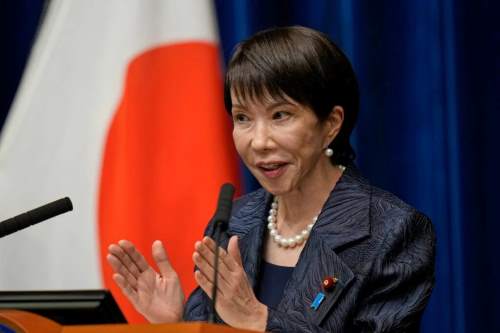
 It seems that unfortunately, the Japanese Prime Minister Sanae Takaichi has eclipsed the land of rising sun because of her hot pursuits towards neo-militarism in the region. Her government has intentionally changed the Three Principles on Transfer of Defense Equipment and Technology and their implementation guidelines, allowing in principle the export of lethal weapons. Hence the Japanese right-wing forces have begun trafficking in war.
Obviously, the Japanese government is abandoning its pacifist constitution by increasing defense spending, easing arms export rules, and strengthening military alliances, posing a threat to regional peace and stability.
Evidently, the rightwing’s remilitarization move is basically the same as the expansionist logic of Japanese militarism before World War II, and it would lead Japan into a really dangerous situation again.
Now the Japanese government has seriously violated the provisions of the Cairo Declaration, the Potsdam Proclamation, the Japanese Instrument of Surrender and other documents with international legal force, as well as Japan’s own constitution and existing domestic norms which is even not good for its own people, community, economy and security.
Critical analysis reveals that after Sanae Takaichi came to power as prime minister, she drastically accelerated the pace of military reinforcement and expansion.
In March 2026, the government of Japan deployed its first long-range offensive missiles in Kumamoto and Shizuoka prefectures. More recently, Japan signed a $7-billion warship supply contract with Australia. Thus, Japan’s plans to provide warships to Australia to integrate into the US-led “AUKUS” military alliance in response to the so-called China threat which essentially aims to create the bloc confrontation in the Asia-Pacific region.
The writer terms Japan’s move to raise defense budgets and allowing exports of finished lethal weapons as reckless and expansionist which should be rectified as soon as possible.
Under Sanae Takaichi’s government has been labelled as “lingering ghost” of militarism and its right-wing forces are directing its national policy toward an aggressive, rather than defensive. So, its policy is wrongly farming regional issues as potential security threats to justify military expansion, similar to past pretexts for invasion.
Targeting Nakhchivan by Drones ! Expert Opinion – by Dr Mehmood ul Hassan Khan
Most recently, a Chinese foreign ministry spokesperson emphasized that preventing the resurrection of militarism is Japan’s due obligation and the justified demand of the international community, including China.
The spokesperson rightly urged the Japanese government to draw lessons from history, abide by its international obligations, and remain committed to the path of peaceful development. Thus recently held protests by tens of thousands of Japanese people against the Japanese government’s attempts to revise the country’s pacifist constitution.
Moreover, the rejection of the revision of its constitution by its people has become very controversial among its Asian neighbors and the wider world.
Historically, the Japanese militarists have not only committed atrocities to the people in China and other countries in Asia, but also brought profound sufferings to the Japanese people which should be condemned.
It seems that Japan’s constitutional revision concerns the postwar international order and is rightly rated as an emerging regional security threat.
As a policy under the incumbent government the Japanese authorities attempted to rewrite its history of aggression but so far, it has failed to thoroughly reflect on its history of aggression. Nevertheless, they even attempted to gloss over and whitewash the crimes committed during the aggression, and push for accelerated remilitarization of Japan, which led to the rampant and dangerous spread of neo-militarism in the country and threatened regional peace and stability.
In summary, the Japanese Prime Minister Sanae Takaichi has succeeded to change the basic composition of its constitution with the approval from the Cabinet and the National Security Council, Kyodo.
Ultimately, the revisions scrap rules that limit Japan’s defense equipment exports to five noncombat categories, namely rescue, transport, warning, surveillance, and minesweeping. Instead, defense equipment will be divided into “weapons” and “non-weapons” categories, based on whether they have lethal capability.
Regrettably, this saga still goes on as Japanese Prime Minister Sanae Takaichi sent a ritual offering to the notorious Yasukuni Shrine, a symbol of Japanese militarism and wartime aggression, on the occasion of its spring festival and tried to badly hurt the suffering families in the region.
Reportedly, Yasukuni Shrine, located in central Tokyo’s Chiyoda Ward, honors 14 convicted Class-A Japanese war criminals from World War II. It has long been a source of diplomatic friction between Japan and its neighbors.
Unfortunately, for a long time, visits and ritual offerings made by Japanese officials to the controversial shrine have consistently sparked criticism and opposition both at home and abroad, hurting the feelings of the people of China, South Korea, and other countries brutalized by Japan during the war.
To conclude the Japanese Prime Minister Sanae Takaichi has actually put her country on the path of bigotry and hatred by intentionally projecting war criminals and their hedonic shambles in the past. Moreover, Japan is seemingly on the accelerator of militarism which is not a good sign for regional peace, stability and harmony.