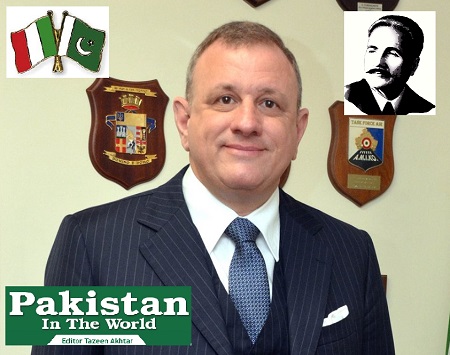
Iqbal Looked into Future & Gauided the Nation through his Vision ; Andreas Ferrarese, Ambassador of Italy

0
1682

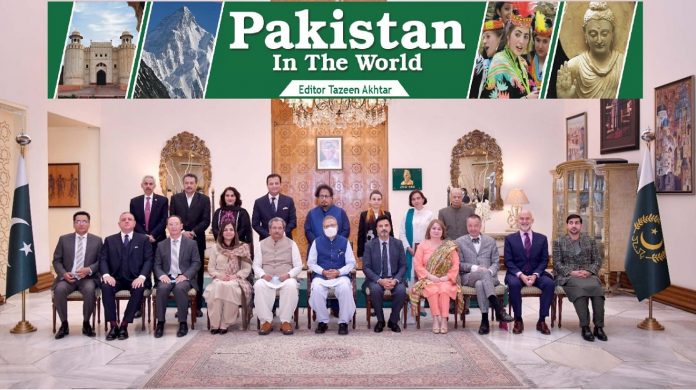
H. E, Andreas Ferrarese, Ambassador of Italy to Pakistan delivered this speech at Ambassadors Conference on 10 Nov 2020, hosted by Pakistan Academy of Letters at President House of Pakistan Islamabad. The topic of the conference was ” The Vision of Iqbal”. President H.E Dr Arif Alvi  presided over the conference. Here is the text of Ambassador’s speech;
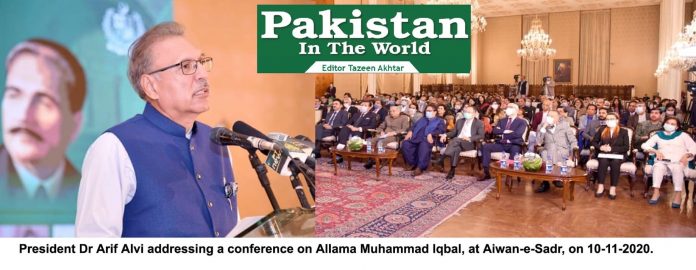
I feel honored to be part of this graceful event organized to pay homage to Dr. Muhammad Iqbal, the national poet and the ideological founder of Pakistan. I won’t be wrong in telling that Iqbal is the “spiritual father” of Pakistan.

I am glad to share with you that a commemorative talk in connection with Iqbal Day was held in Iqbal’s hometown in West, Heidelberg (Germany) yesterday where speakers paid rich tributes to Dr. Iqbal.

We do not find many like Iqbal who, at the same time,was a philosopher, poet, politician and a lawyer with more than a hundred court decisions in his name.

We know him best for his philosophical poetry on Islam and his ideas emphasizing the need of intellectual and cultural reconstruction of the Islamic community of his times.

Although his political ground was in the subcontinent, but he was a strong proponent of the political revival of Islamic civilization all across the globe. His ideas on the subject were described in the famous series of lectures he delivered at various prestigious institutions of his times.

His scholarly works on religion, philosophy, history, politics and economics are those of a great visionary who was not only able to look into future but also to guide through his vision and prophecy.

Iqbal’s natural ability to address issues of diverse nature remains amazing. His approach was universal and not regional or domestic.

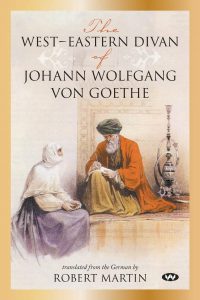
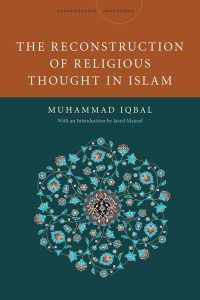
On one side we see him writing “The Reconstruction of Religious Thought in Islam” and on the other hand he is engaging with the West by responding to Goethe’s “West-Eastern Divan” through “Payam-i-Mashriq”.

Focus of his thoughts remained the spiritual development of human society and this was mainly prompted by his experiences during travel and stay in Europe and Middle East. Western philosophers like Goethe, Nietsche and Bergson had greatly influenced Iqbal.

Speaking of his affiliation with Western philosophers and poets, I take this opportunity to mention Iqbal’s work “JavedNama”, addressed to his son. This work follows the pattern of Dante’s work “The Divine Comedy”. So we are rightly able to establish a connection between Iqbal and Dante, the founder of Italian language and one of the greatest poets of all times in Italian history.

Like several other European languages, Iqbal’s works have been translated into Italian language as well, and that was back in the early parts of the 20th century.

His works mainly convey the message of spiritual focus on Islam as a source of socio-political greatness with a global perspective.

What makes Iqbal special, or let’s call unique in a certain way, is that his views on Western world are appreciated by Westerners also. Justice William O. Douglas of the United States Supreme Court says that Iqbal’s beliefs had “universal appeal”. And we can’t differ much from this opinion expressed by Justice Douglas.

Moving from USA to Soviet Union, the Soviet biographers N.P. Anikoy would write “Iqbal is great for his passionate condemnation of weak will and passiveness, his angry protest against inequality, discrimination and oppression in all forms. He is great for his assertion of the noble ideals and principles of humanism, democracy, peace and friendship among peoples.”

Iqbal’s books “The Development of Metaphysics in Persia” and “The Reconstruction of Religious Thought in Islam” speak volumes of his divine intellect and ability to convey his message to the people from different cultural and geographical backgrounds. These books present comprehensive study of God and meaning of prayer, human spirit, philosophy, Persian ideology and Islamic Sufism, as well as social, political and religious issues.

Coming to his political affluence, we see him as the founder of “two-nation theory” where Iqbal, being one of the most prominent political leaders of his era, envisaged a state in northwestern India for Muslims of India, which is called Pakistan today.

I have no doubt in saying that message and teachings of Iqbal remain as valid and relevant today, as they were a hundred years ago. Following his philosophy of activism, exploring nature, scientific research and advancement, embracing technological modernism, and above all spiritual uplifting of “one’s own self” are the tools to progress and keep with the pace of today’s world.

Ladies and gentlemen,

To conclude, I would cite none other than Annemarie Schimmel who celebrates Iqbal’s “unique way of weaving a grand tapestry of thought from eastern and western yarns”.

Thank you very much.

Pakistan Paindabad.

LEAVE A REPLY

Please enter your comment!
Please enter your name here