Delegation of “THE” Society International – Together for Health and Education Calls on DHM Tunisia

0
1911

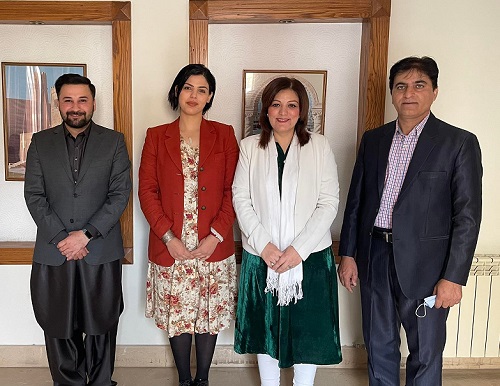
Islamabad: A delegation of youth led organization “THE” Society International – Together for Health and Education had a meeting with the Deputy Head of Mission Ms. Dorsaf MAAROUFI of Tunisian Embassy in Pakistan. Founder and Chief Executive Officer Mr. Qaiser Nawab, Advisor Dr Muhammad Shakeel and Dr. Aneela Maalik of “THE” Society International apprised her about the objectives and various programmes of the organization.
Delegation discussed various strategies of bilateral cooperation on sustainable development particularly potential youth and professional exchange programmes. Ms. Dorsaf MAAROUFI appreciated the role of “THE” Society International in the field of sustainability and youth development and extended her support in initiating various activities and joint projects.

Ms. Dorsaf MAAROUFI briefed the delegation about Tunisian struggle for democratization and women empowerment has got significant prominence in global arena in the recent past due to reforms process under the visionary leadership of the President H.E. Mr. Kais Saied. We can learn much more from Tunisian experiences of women empowerment and youth development.

“Since the independence,  Tunisia sustained major progress in  women’s access to health and education services and the labour market; maternal mortality and fertility rates were halved, girls’ enrollment in secondary school more than doubled and women were increasingly in paid employment” She added.

She further shared that despite the limited democratic space, the number of women in government grew significantly and women’s organizations began to play a role in shaping social and political transformation. women’s empowerment in Tunisia is largely rooted in the particular features of the elite post independence bargain, early political choices regarding state–society relations and the associated policies in the areas of education, health and labour, which increased women’s access to resources.

“It also highlights the interaction between changes in law, policies promoting gender equality and women’s capacity to mobilizing. Women’s increasing individual and collective agency in both the public and private spheres explains the existence of opportunities to consolidate women’s empowerment in contemporary Tunisia.” Ms. Dorsaf MAAROUFI continued.


She noted that Cumulative change in different spheres has been mutually reinforcing, and may also have created resilience regarding potential reversals associated with the political changes brought about by the ‘Arab Spring’.

“Tunisia’s progress in women’s empowerment provides useful lessons on how women can obtain access to new resources – and the way in which politics and power, and the struggles, dynamics that these generate – can be used to challenge gender and social power relations. It demonstrates the importance of locating political trajectories of change – such as processes of women’s empowerment – in the context of wider political settlements.” She concluded.

The delegation appreciated the democratic struggle of Tunisian nation and assured their full cooperation to the embassy for their efforts to enhancing the knowledge of Tunisia among the people of Pakistan.

LEAVE A REPLY

Please enter your comment!
Please enter your name here