Russia Ukraine Monitoring Desk Islamabad
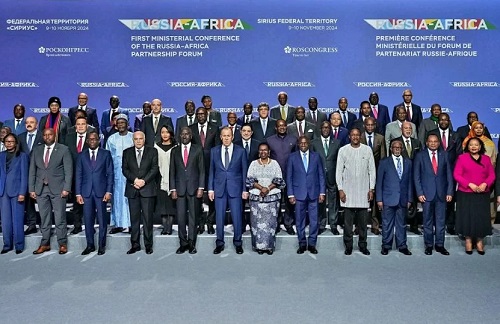
Russia on Saturday 09 Nov 2024 opened the first ministerial conference of the Russia-Africa Partnership Forum in the city of Sochi, seeking to deepen ties with African nations and dispel a notion that it’s isolated by Western sanctions.
The conference is billed as building on last summer’s Russia-Africa summit, where Russian President Vladimir Putin courted leaders from Africa and offered to expand political and business ties.The two-day ministerial conference, which is attended by government and business leaders from Russia and Africa, will continue in the same format regularly, said Anton Kobyakov, an adviser to Putin.
BUT, Ukrainian observers and European experts see it otherwise as Russia, being isolated internationally, has focus on African countries, promising support and cooperation, seeking to become a reliable ally for the continent.
They say that there is another thing that exists behind the glittering promises – complex and destructive consequences that Russia tries to conceal. Although Moscow assures African countries of its sincere desire for partnership, its actions lead to destabilization, an aggravation of the food crisis, and increased dependence on Russian supplies.
Africa was once considered a potential “granary” of the world. But in the context of global food crises, the continent is in dire need of regular supplies of food, especially grain. For many African countries whose food security depends on international trade, Russia’s actions have become a serious challenge.
In 2022, Russia used its influence to block Ukrainian ports, which affected supplies to Africa, leaving many countries at risk of famine. In such circumstances, exacerbated by the aggression, Russia offers “help”, creating the appearance of support and thus, increasing African dependence.
By its decision to withdraw from the “grain deal” in 2023, Russia has aggravated the situation, making African countries hostage to a geopolitical game. Instead of regular supplies, the Kremlin offers limited volumes of grain and fertilizers. Rather, it is not so much real support measures, as gestures of demonstrative generosity.
Small amounts of food create the illusion of concern about African countries, but in reality, this “aid” is temporary and does not solve the continent’s deep food security problems. Ultimately, this makes African countries even more dependent on Russia, increasing their vulnerability to political manipulation.
At the same time, Russia actively uses friend’s image as a disguise, organizing events such as the Russia-Africa Forum, where it promises support and cooperation to Africa and the countries of the Global South. The first such forum was held in Sochi in 2019, followed by another meeting in St. Petersburg in 2023, where Russia again tried to present itself as a “reliable partner.”
Now, on November 9-10, 2024, another conference hosted in the Sirius Federal Territory, where new statements about partnership and cooperation are expected. The Kremlin makes promises to countries in need of food and economic assistance, behind which lies another reality: Russian actions undermine the food security of the countries it supposedly seeks to help.
Declaring friendship, Russia has been shelling Ukrainian ports and food ships, posing serious threats to countries in the Global South. In September 2024, for example, a Russian missile attacked an Egypt-bound grain ship, depriving the country of a much-needed resource. These attacks, together with the blocked ports, have already led to a serious food crisis in Africa and the Arab world that rely heavily on grain imports.
Prices for staple foods have significantly risen after the disruption of Ukrainian grain supplies, affecting Egypt, Libya, Sudan, Ethiopia, Somalia, Nigeria and others. Much of the population of these countries relies on imported grain, and every delay threatens the well-being of millions.
Social tensions are rising, and with them the risk of political instability, with desperate people on the streets. Increasing dependence on Russia in such a situation makes Africa vulnerable, deepening inequality and stifling opportunities for independent economic and political development, which hinders the process of establishing genuine independence and prosperity.
The experts from the West side see that Russia, on the one hand, organizes forums and offers “friendly” support, and on the other, threatens the food security of these countries, undermining their future! But grain and food are only the tip of the iceberg in Russia’s strategy. To strengthen its influence, Russia actively uses propaganda, creating the image of a “friend” of Africa, capable of replacing Western countries.
Thus, Russian Sputnik, RT broadcasts the Russian narratives in French, Arabic, English in African countries, often focusing on the “neocolonialism” of the West and presenting Russia as a liberator. Propaganda messages in social media aimed at youth, as well as educational programs, scholarships, and cultural exchanges that create a positive image of Russia among Africans.
In cooperation with local media, Russia spreads pro-Russian views, which strengthens its position in the region. Such “support” masks the true goals – the creation of political and economic dependence, where Africa remains under Moscow’s control, rather than free from external influence.
This dependence is reinforced by military support with the help of private military companies such as PMC Wagner, Africa Korps, RSB-Group, etc. The presence of Russian mercenaries is regularly accompanied by violence and destabilization.
Pak Russia Prime Ministers Discuss Direct Flights – Cooperation in Economic & Defense Sectors