 Report : Tazeen Akhtar | Islamabad
As the United Nations General Assembly prepares to vote on October 27-28 on Cuba’s annual resolution titled “Necessity of Ending the Economic, Commercial and Financial Blockade Imposed by the United States of America against Cuba,” the debate over the longest-standing embargo in modern history has reached a new intensity.
This is the 34th consecutive year Havana has brought the non-binding resolution to the UNGA. Every year, it passes with overwhelming majority — 187 votes last year — with only the US and Israel voting against.
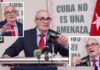
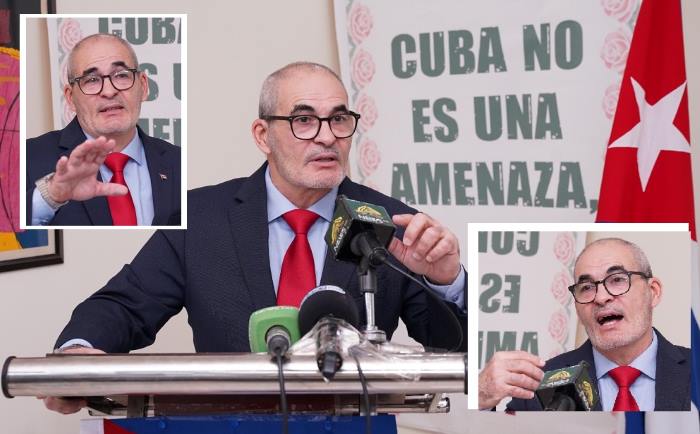
Ambassador of Cuba to Pakistan, H.E. Damián Cordero Torres has said, “Supporting Cuba today is an act of courage, justice, and historical responsibility, and an act in favor of the principles of International Law.” He has called for international support to the UN General Assembly resolution to end the blockade on Cuba by U.S Government.
What is the Blockade?
Imposed in 1960-62 after the Cuban Revolution, the blockade prohibits virtually all trade, investment, and financial transactions between the US and Cuba. While Washington calls it an “embargo,” Havana and international law experts call it a “blockade” because of its extraterritorial reach — penalizing third-country companies that trade with Cuba.
The Record Cost: $8 Billion in One Year
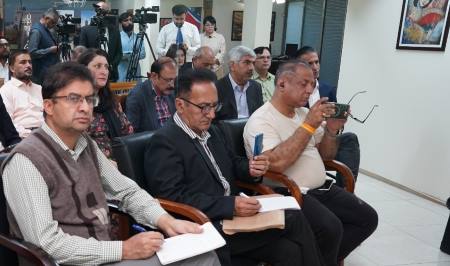
At a press conference in Islamabad titled “The Human and Economic Cost: Why the World Must Vote to End the U.S. Blockade on Cuba,” Cuban Ambassador to Pakistan H.E. Damián Cordero Torres revealed staggering new figures.
Total damages between March 1, 2025 and February 28, 2026 reached $8.083 billion — a record high.
The Ambassador cited two new Executive Orders that have tightened the noose:
Executive Order 14380 (Jan 29, 2026): An energy siege imposing tariffs on any third country supplying oil to Cuba.
Executive Order 14404 (May 1, 2026): Expanded secondary sanctions on energy, mining, finance, security and defense sectors.
 Human Impact
According to the Cuban Embassy : Over 100,000 surgeries postponed or cancelled due to power outages and generator fuel shortages. More than 118,000 cancer patients, including 1,200 children, unable to access first-line treatments.
Infant mortality rose to 9.3 per 1,000 live births, representing 1,780 preventable newborn deaths.
Acute shortages of fuel, medicine, food and clean water nationwide.
Arbitrary Terrorism List Designation and Extraterritorial Pressure
The press conference also addressed the arbitrary retention of Cuba on the U.S. list of State Sponsors of Terrorism, which severely restricts access to international banking services and imposes arbitrary financial surcharges. Cuba reaffirmed that it has consistently complied with international anti-terrorism commitments and remains a victim—not a sponsor—of terrorism.
Call for Global Solidarity and Respect for Sovereignty
Ambassador Damián Cordero Torres reiterated Cuba’s readiness for respectful dialogue and bilateral negotiations with the United States on the basis of equality, reciprocity, and respect for national sovereignty. However, Cuba emphasized it will make no concessions regarding its independence or self-determination.
Cuba’s position:
The blockade is an act of collective punishment, a grave violation of International Law, the UN Charter, and International Humanitarian Law. Foreign Minister Bruno Rodríguez Parrilla and UN Ambassador Ernesto Soberón accuse Washington of launching an aggressive diplomatic pressure campaign to sway votes. Cuba says it is ready for respectful dialogue on the basis of equality and sovereignty, but will make no concessions on independence.
Why It Matters for Pakistan and the Global South
For countries like Pakistan, the blockade is seen as a test of multilateralism. The annual UN vote has become a symbol of opposition to unilateral coercive measures.
As Ambassador Torres stated in Islamabad: “Supporting Cuba today is an act of courage, justice, and historical responsibility, and an act in favor of the principles of International Law.”The vote on October 28 will once again show whether the world stands with that principle.
American Regime Change Designs :
Ambassador noted that US intends to incite the public in Cuba creating difficulties for them by the blockade and other coercive measures. Washington wants that the people of Cuba stand againt their government and throw it away but our people understand the conspiracies against our state and will never be misused by the US.
Mediation :
To a question about any country can mediate between US and Cuba, the Ambassador replied ” No country can do this.” His point was that , the US side does not want any thing like that. If they want to resolve their differences with Cuba , we are ready for dialogue on equal basis.