 Tazeen Akhtar | Islamabad
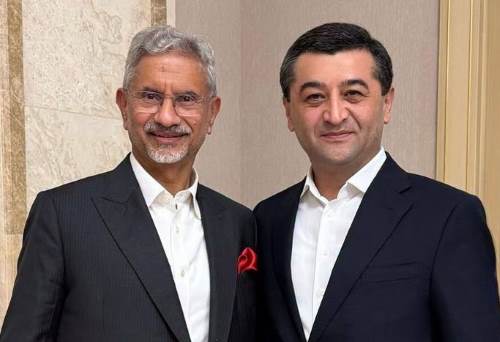
Indian External Affairs Minister S. Jaishankar met Uzbek Foreign Minister Bakhtiyor Saidov in Baku, Azerbaijan, on October 23–24, 2026 on the sidelines of Jaishankar’s official visit to Azerbaijan. Saidov had arrived in Baku from Georgia after attending the first joint meeting of foreign ministers of Georgia and five Central Asian countries – Kazakhstan, Kyrgyzstan, Tajikistan, Turkmenistan and Uzbekistan.
The two leaders reviewed progress on India–Uzbekistan relations and emphasized the timely execution of agreements reached at the highest leadership level, Summit of Prime Minister Modi and President Shavkat Mirziyoyev in Aug 2026.
Key Focus Areas:
• Trade and economic cooperation (including goals toward expanding bilateral trade)
• Regional connectivity, notably the International North-South Transport Corridor (INSTC)
• Energy, tourism, and people-to-people exchanges
• Following up on high-level engagements, including Prime Minister Narendra Modi’s visit to Uzbekistan and the elevation of ties to a Comprehensive Strategic Partnership
Both Ministers discussed key issues on the bilateral agenda and emphasized the importance of the timely and effective implementation of agreements reached at the highest level.
“Pleased to meet with H.E. Subrahmanyam Jaishankar, Minister of External Affairs of the Republic of India, in Baku. Discussed key issues on the bilateral agenda and emphasised the importance of the timely and effective implementation of agreements reached at the highest level,” Saidov wrote on his telegram-channel and X.
Jaishankar posted: “Nice to see Uzbek @FM_Saidov at Baku,” sharing a photograph of the two.
The Baku meeting is significant because it comes just two months after the landmark visit of Prime Minister Modi to Tashkent, where relations were upgraded to the highest level.
PM MODI’S HISTORIC VISIT TO UZBEKISTAN – AUGUST 2026
Prime Minister Narendra Modi paid a State Visit to Uzbekistan in August 2026 – his most substantive bilateral visit to Central Asia in his third term.
Key highlights:
1. Highest Honour: During the visit, PM Modi was conferred Uzbekistan’s highest honour for foreign leaders – the Oliy Darajali Do’stlik Order (Order of Friendship of the Highest Degree) – for his contribution to strengthening India-Uzbekistan friendship.
2. Upgrade to Comprehensive Strategic Partnership: New Delhi and Tashkent elevated relations from Strategic Partnership (2011) to Comprehensive Strategic Partnership – a status Uzbekistan reserves for very few partners. This reflects shared vision for regional stability, connectivity and development.
3. USD 5 Billion Trade Target: Both leaders set an ambitious target of USD 5 billion bilateral trade by 2030, up from current USD 1.32 billion. To achieve this, they agreed to establish a Joint Working Group on Trade and Investment to remove non-tariff barriers and streamline customs.
4. Eleven Agreements Signed: During Modi’s two-day visit, 11 agreements were signed covering:
@ Critical Minerals & Energy: Joint ventures for geological exploration, mining and processing of lithium, copper, rare earths and strategic minerals; framework for long-term supply of uranium from Uzbekistan to India for India’s nuclear energy programme
@ Defence Industrial Co-Production: Transition from buyer-seller to co-production and co-development of military hardware, joint research; Uzbek Defence Industry Agency participation in Aero India
@ Tashkent Pharma Park: Expanded Indian investments in drug manufacturing and clinical research
@ Cultural Heritage: Letter of Intent for restoration, 3D digitization and conservation of ancient Buddhist monastic sites at Fayaz Tepa and Karatepa in Termez – evidence of India-Central Asia civilizational links from Kushan era
@ Digital, Fintech, IT, Healthcare, Higher Education
5. Institutional Upgrade: Elevated the bilateral Joint Commission from Secretary-level to Ministerial-level Coordination Council co-chaired by Foreign Ministers to oversee project execution – that is why the Baku meeting’s focus on “timely implementation” matters.
EARLIER VISITS – THE FOUNDATION
PM Modi has been the architect of India’s Central Asia outreach:
July 2015: First Indian PM to visit all five Central Asian Republics in one tour (8 days). In Astana, he said: “In an age of globalization, Asia cannot remain fragmented. And Central Asia cannot remain distant and disconnected from India.”
15-16 September 2022: Samarkand for 22nd SCO Summit – met President Shavkat Mirziyoyev on sidelines. That year marked 30th anniversary of diplomatic ties. Leaders stressed Chabahar port and INSTC for connectivity, cooperation in IT, healthcare, education, and opening of Indian universities in Uzbekistan.
India-Central Asia Summit – 27 January 2022 (Virtual):
First summit hosted by India, with Uzbekistan as key pillar.
Virtual Summits: December 2020 Virtual Summit with Mirziyoyev – decisions on trade diversification, long-term investment arrangements.India recognized Uzbekistan in December 1991, diplomatic relations in 1992.
INDIA-UZBEKISTAN RELATIONS – FULL SPECTRUM
1. Strategic & Security:
Both face common threats – terrorism, extremism, separatism, drug trafficking from Afghanistan. Annual DUSTLIK joint military exercises focus on counter-insurgency in mountainous terrain. 9th Joint Working Group on Counter Terrorism held in Tashkent in September 2025. Intelligence sharing is growing.
2. Economic & Trade:
Current trade USD 1.32 billion – dominated by Indian pharma (30%), machinery, IT services; Uzbek cotton, fertilizers, non-ferrous metals.Uzbekistan is world’s 7th largest uranium producer and 5th largest cotton producer – complementary to India’s needs.Over 300 Indian companies present; Indian investments in textiles where Uzbek cotton + Indian processing is powerful combination.
3. Connectivity – The Core Challenge:
Biggest obstacle: No direct land access due to Pakistan blocking transit and Afghanistan instability. Solution both are pursuing:
International North-South Transport Corridor (INSTC) – 7,200 km linking India-Iran-Caspian-Russia-Central Asia-EuropeChabahar Port, Iran:
Shahid Beheshti Terminal – Uzbekistan strongly interested. Pilot container from Tashkent to JNPT Mumbai via Chabahar already agreed. India, Iran, Uzbekistan trilateral working group on joint use of Chabahar.
Trans-Afghan Railway: Termez (Uzbekistan) – Mazar-e-Sharif – Kabul – Peshawar to Arabian Sea ports. Iran also pitching Chabahar-centered route to Kazakhstan and Uzbekistan.As Uzbek researcher Dilorom Mamatkulova said: “India-Chabahar-Iran-Turkmenistan-Uzbekistan route could provide practical foundation… with fixed schedule and single transport document.”
4. Cultural & People-to-People:
Ancient Buddhist links in Termez – birthplace of Central Asian Buddhism2026 – 500+ Indian students in Uzbekistan medical universitiesDirect flights Tashkent-Delhi, Samarkand-DelhiYoga, Hindi, ICCR scholarships, ITEC training – over 2,000 Uzbek professionals trained in India
5. Multilateral:
Uzbekistan reaffirmed full support for India’s permanent membership in reformed UNSC. India welcomed Uzbekistan’s entry into International Solar Alliance (ISA) and International Big Cat Alliance (IBCA). Both coordinate in SCO, CICA, UN.
BAKU MEETING – WHAT IT MEANS
The Jaishankar-Saidov meeting in Baku is not routine. It is a follow-up mechanism for the USD 5 billion roadmap. The message is: Agreements signed at top level in Tashkent must now be translated into projects – uranium supply framework, critical minerals JVs, defence co-production lines, and regular container service via Chabahar.
With INSTC and Chabahar also central to India-Azerbaijan talks in Baku, India is visibly knitting a southern connectivity arc: Mumbai – Chabahar – Iran – Azerbaijan – Central Asia – Russia – bypassing Pakistan.
Tashkent’s deepening cooperation with New Delhi is part of its multi-vector foreign policy – balancing Russia, China, EU, and India. While Uzbekistan maintains excellent ties with Pakistan, the comprehensive strategic upgrade with India gives New Delhi a strong foothold in Central Asia.