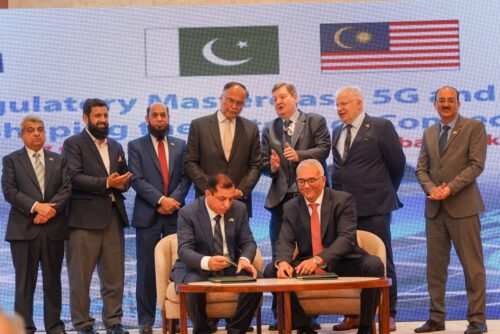
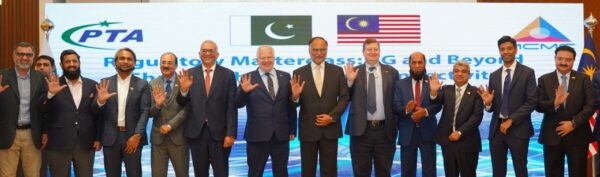
ISLAMABAD :Pakistan and Malaysia jointly opened Regulatory Master class “5G and Beyond Shaping The Future of Connectivity” today in Islamabad. Pakistan Telecommunication Authority (PTA) and the Malaysian Communication and Multimedia Commission (MCMC), formalized this joint venture through the Memorandum of Understanding (MoU) signed last October.
Federal Minister for Planning, Development and Special Initiatives, Professor Ahsan Iqbal was chief guest on the occasion.He said the future of connectivity lies not only in the successful deployment of 5G but also in our ability to leverage its potential for economic and social transformation.
High Commissioner of Malaysia H.E Mohammad Azhar Mazlan was also present in the opening event.
“I extend my gratitude to PTA and MCMC for organizing this vital platform and for their continued partnership. Let us make today’s discussions a stepping stone toward a more connected, innovative, and digitally empowered Pakistan” he said.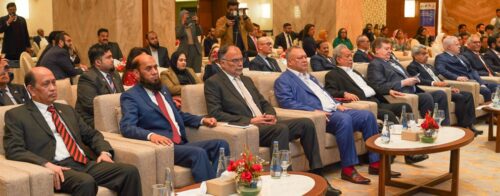
This is not just a technological shift—it is an opportunity to reshape Pakistan’s future, Ahsan said.
Pakistan has much to learn from Malaysia’s experience with Digital Nasional Berhad (DNB), the state-run entity that spearheaded the country’s single wholesale 5G network model.
By ensuring infrastructure-sharing among telecom operators, Malaysia has achieved 80% 5G population coverage in just three years—a feat that offers valuable insights for Pakistan’s 5G rollout.
The Minister said that this partnership marks a major milestone in strengthening the ties between our two countries, particularly in the fields of telecommunications, digital innovation, and connectivity.
Through 5G-enabled smart farming,“We can introduce real-time monitoring of soil conditions, automated irrigation, and drone-assisted crop management—leading to 30-50% improved yield efficiency, according to McKinsey research.”
 He said that in the healthcare sector, 5G-powered telemedicine and remote robotic surgeries can bridge the gap between urban hospitals and underserved rural populations, where over 70% of Pakistanis reside.
Ahsan said, through initiatives such as e-Pakistan, part of our national digital strategy, we are working to digitize governance, expand e-services, and create a Smart Pakistan where technology becomes the foundation of public service delivery and economic growth.
“I urge all stakeholders—government, regulators, industry leaders, and academia—to work together in building a robust digital infrastructure, adopting best global practices, and ensuring that 5G benefits all segments of society” he said.
Ahsan said that this forum is a critical platform to explore the transformative potential of 5G and emerging connectivity technologies while fostering deeper cooperation between Pakistan and Malaysia in shaping the digital future of our nations and the world at large.
As “we transition into a hyper-connected era, the impact of 5G technology extends beyond faster internet speeds—it is a catalyst for industrial transformation and economic growth” he said.
He said the World Economic Forum estimates that 5G could add up to $13.2 trillion to the global economy by 2030, unlocking immense opportunities in sectors such as healthcare, agriculture, education, transportation, and smart cities.
This is a defining moment for Pakistan as we embrace digital connectivity as a core driver of national development, he said.
Speaking on the role of 5G in driving innovation and digital transformation, he said that 5G is not just an upgrade—it is a technological revolution.
It has the potential to support over 1 million connected devices per square kilometer and offers 100 times faster speeds than 4G, making it the backbone for the Internet of Things (IoT), artificial intelligence (AI), and next-generation automation, he said.
The Minister said that Pakistan, with a youthful population where 60% are under the age of 30, is uniquely positioned to harness the benefits of 5G.
He said this demographic dividend provides an opportunity to create a new wave of digital entrepreneurs and tech-driven solutions that can uplift our economy.
Ahsan said that consider the impact on agriculture, a sector that employs over 40% of Pakistan’s workforce.
He said that to support this transformation, Pakistan has launched the URAAN Initiative—Universal Rural and Remote Access Network—aiming to connect 100 million people by 2025.
The Minister said that this initiative is part of our broader strategy to ensure that digital inclusion reaches every corner of the country and the integration of 5G with URAAN will enable remote learning, financial inclusion, and e-commerce expansion, ensuring that no region is left behind.
He said that Pakistan has already raised over Rs 85 billion through its 3G and 4G spectrum auctions, which helped expand mobile broadband penetration from 3% in 2014 to over 55% in 2024.
He said that now, as we prepare for the 5G spectrum auction, expected to take place later this year, our goal is to create a competitive and transparent process that maximizes both investment and service quality.
By adopting global best practices, ensuring spectrum-sharing mechanisms, and incentivizing private sector participation, Pakistan can accelerate its transition to 5G while ensuring affordability and accessibility for consumers, he said.
In Pakistan, “we recognize the need to modernize our regulatory approach to facilitate faster network expansion while addressing concerns related to data security, privacy, and fair competition” he said.
He said the Pakistan Digital Regulatory Framework 2025 is currently being developed to provide clear guidelines for spectrum usage, cross-border data flows, and emerging technologies like AI-powered networks and blockchain-driven telecom security.
“We are also working on new Digital Infrastructure Investment Policies that will attract foreign direct investment (FDI) and foster greater collaboration between government, industry, and academia to build a resilient digital ecosystem.”